SaaS security is not a collection of products around the edge of an application. It is the set of trust decisions the product makes every time a user, service, API, integration, administrator, or AI agent tries to reach a resource or take an action.
That distinction becomes more important as a SaaS company scales. More tenants appear. More integrations are added. More administrators receive privileged access. More non-human identities enter the environment. AI features retrieve customer data and begin calling tools. A design that felt reasonable when the product had ten customers can become a cross-tenant exposure path when it has ten thousand.
High John Technology approaches SaaS security from the architecture layer. We map the principals, tenants, resources, actions, data paths, integrations, identities, policy decisions, logs, and recovery controls that define what the product is actually allowed to do. The goal is not to bolt security onto a growing product. It is to make security part of the product’s operating model.
That need is visible in current research. The Cloud Security Alliance’s State of SaaS Security 2025 report, based on a survey of 420 IT and security professionals, highlights problems including fragmented administration, over-privileged access, shadow SaaS, non-human identities, and expanding SaaS-to-SaaS and AI integrations. OWASP’s 2026 Top 10 for Agentic Applications adds another layer: autonomous systems can misuse tools, privileges, memory, and connected resources in ways traditional application controls may not anticipate.
Table of contents
- What SaaS security actually means
- Start with the trust-boundary map
- Tenant isolation is an authorization problem
- Authentication is not authorization
- Non-human identity needs the same rigor
- AI agents need an external enforcement boundary
- Integrations expand the product’s attack surface
- Observability, revocation, and recovery
- Red-team the release gate
- Frequently asked questions
What SaaS security actually means
A useful SaaS security model can be reduced to a repeated decision:
Who is asking to do what, to which resource, inside which tenant, under what conditions?
Every important request should resolve that question before the action occurs.
The components are straightforward in theory:
- Principal: user, administrator, service, integration, workload, or AI agent;
- Tenant: the customer or organizational boundary that constrains the request;
- Resource: record, document, API object, secret, workflow, model, or infrastructure asset;
- Action: read, create, update, delete, export, send, execute, approve, or administer;
- Context: device, network, time, delegated user, environment, data classification, approval state, or other conditions;
- Decision: allow, deny, or require additional authorization.
A mature product expresses those rules intentionally. An immature product spreads them across route handlers, UI checks, database filters, and tribal knowledge until nobody can explain the effective policy anymore.
SaaS security is therefore partly an authorization-design problem, partly a data-isolation problem, partly an identity problem, and partly an operational-evidence problem.
Start with the trust-boundary map
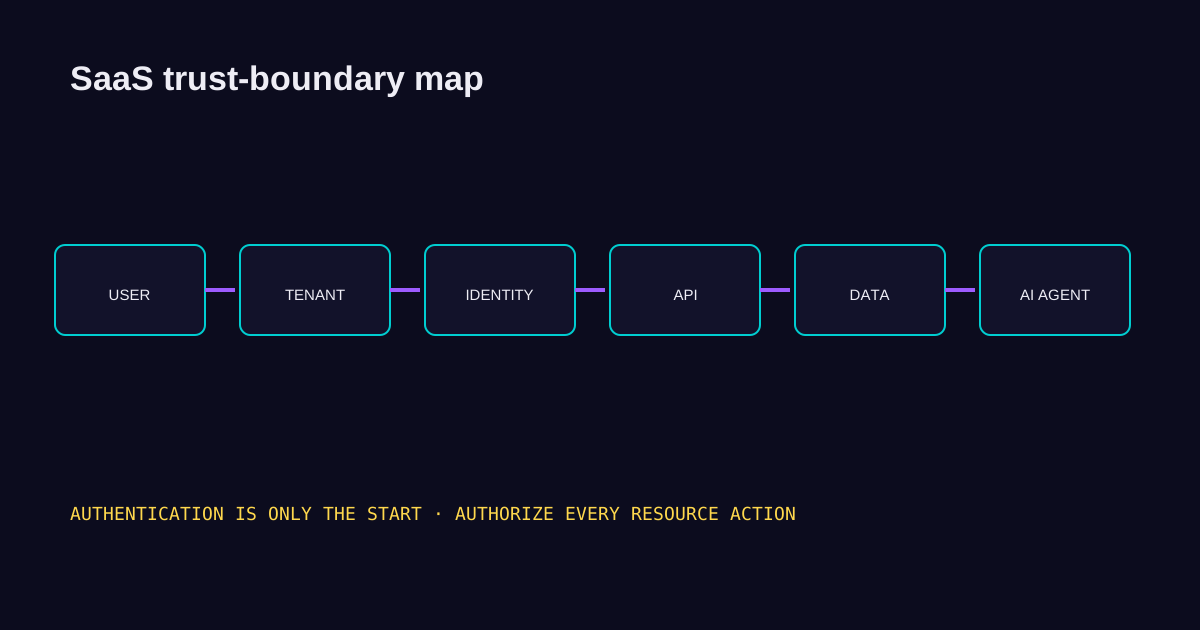
Before buying another security product, draw the system.
Start with users and tenants. Add authentication providers, frontend clients, backend services, APIs, databases, object stores, queues, caches, analytics, support tools, admin panels, CI/CD, cloud infrastructure, third-party SaaS integrations, model providers, vector stores, and AI agents.
Then draw the trust transitions.
Where does a request cross from public to authenticated? Where does tenant context enter? Where does one service call another? Which systems hold customer data? Which service accounts have standing access? Where can an administrator impersonate a customer? Where can a support tool export data? Which AI system can invoke external tools?
This map is more useful than a generic checklist because it ties controls to actual relationships.
NIST’s Cybersecurity Framework is intentionally broad and risk-based. It can help leadership organize cybersecurity outcomes across Govern, Identify, Protect, Detect, Respond, and Recover. But a SaaS team still has to translate those outcomes into its architecture. The trust map is where that translation begins.
Tenant isolation is an authorization problem
Multi-tenancy creates one of the defining risks in SaaS: a request from Tenant A reaching data or actions belonging to Tenant B.
Teams often think of tenant isolation as a database choice. Database design matters, but isolation is wider than storage. Tenant context must survive every layer that uses it.
That includes:
- API authorization;
- database queries;
- cache keys;
- background jobs;
- file and object storage paths;
- search indexes;
- analytics pipelines;
- support tools;
- exports;
- webhooks;
- AI retrieval systems;
- asynchronous queues;
- internal administration.
The rule should be enforced where the resource is accessed, not merely assumed because the UI only displayed the current tenant.
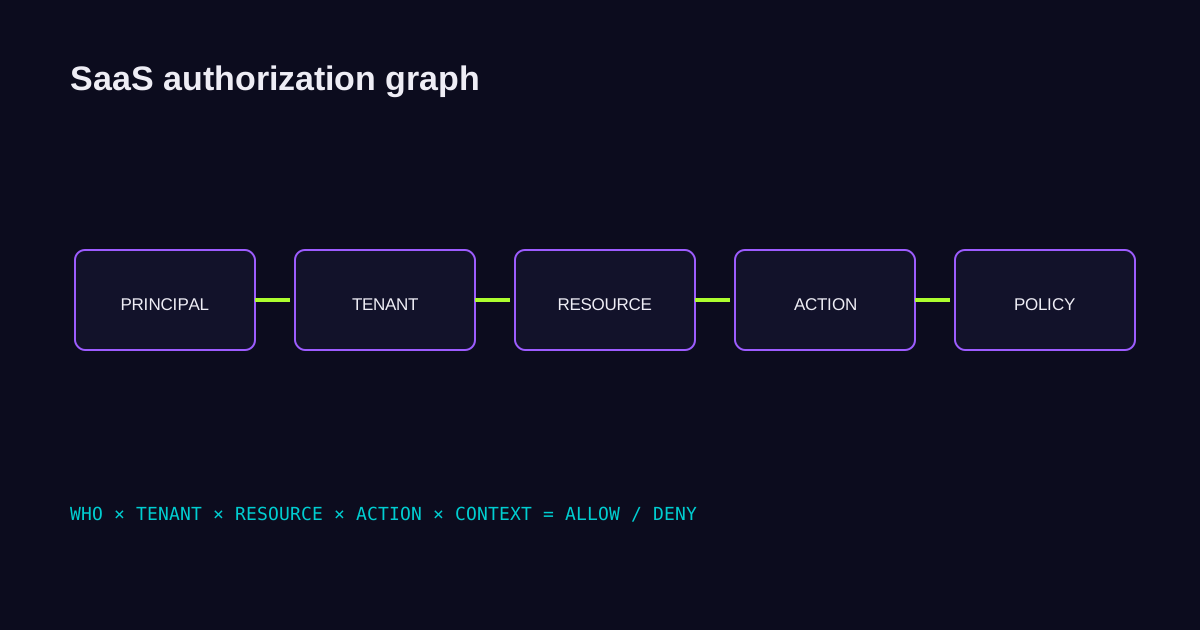
A strong authorization decision can be modeled as:
principal × tenant × resource × action × context → allow / deny
This becomes especially important for AI retrieval. If a vector search retrieves across tenant boundaries and the application filters the result only after generation, the boundary is too late. Permission-aware retrieval should constrain what enters the model context in the first place.
Authentication is not authorization
Authentication answers Who are you? Authorization answers What may you do here?
A user can be properly authenticated and still be unauthorized for a record, tenant, administrative function, or export. SaaS security fails when those two questions collapse into one.
Common warning signs include:
- authorization enforced only in the frontend;
- role checks without resource-level checks;
- administrator APIs protected by the same broad token as normal operations;
- tenant IDs accepted directly from client input without validating membership;
- service-to-service calls trusted because they originate inside the network;
- APIs with write scopes much broader than the current task requires;
- shared service credentials that erase attribution.
The better pattern is explicit authorization at the action boundary. Central policy engines are useful for some products, but they are not mandatory. The important requirement is that the rule is deterministic, testable, consistently enforced, and observable.
Security architecture should also define elevated workflows. Support impersonation, billing changes, user-role changes, tenant exports, destructive actions, secrets access, and production administration deserve stronger controls than ordinary reads.
Non-human identity needs the same rigor
Modern SaaS products have more identities than employees and customers.
CI/CD runners, cloud workloads, serverless functions, integration workers, data pipelines, automation services, vendor connectors, and AI agents all act on behalf of the business. Those non-human identities need ownership and lifecycle controls.
A dedicated service identity should answer:
- What system owns it?
- Which human team owns the system?
- What resources can it reach?
- What actions can it perform?
- How are credentials issued?
- Can credentials expire or rotate?
- How quickly can access be revoked?
- Are actions attributable to this identity in logs?
- Is the privilege still needed?
Shared long-lived API keys make those questions harder to answer. Short-lived workload credentials and narrowly scoped tokens reduce standing privilege where the architecture supports them.
The Cloud Security Alliance’s SaaS-security research specifically identifies non-human identities and over-privileged API access as emerging challenges. The lesson for product teams is not to wait until agentic AI arrives before building an inventory of machine identities.
AI agents need an external enforcement boundary
Agentic systems change the security model because a model can choose which tool to call and can chain actions together based on probabilistic reasoning.
That does not mean the model should be trusted to decide whether the action is authorized.
OWASP’s 2026 agentic-security guidance focuses on risks that arise when autonomous systems interact with tools, memory, identities, external services, and other agents. The safest architecture keeps authorization outside the model.
A tool call should pass through a policy or control layer that knows:
- the agent identity;
- the delegated human or system context where applicable;
- the tenant;
- the target resource;
- the requested action;
- the permitted scope;
- the current approval state;
- whether a human must authorize the action;
- whether the request should be logged, denied, or escalated.
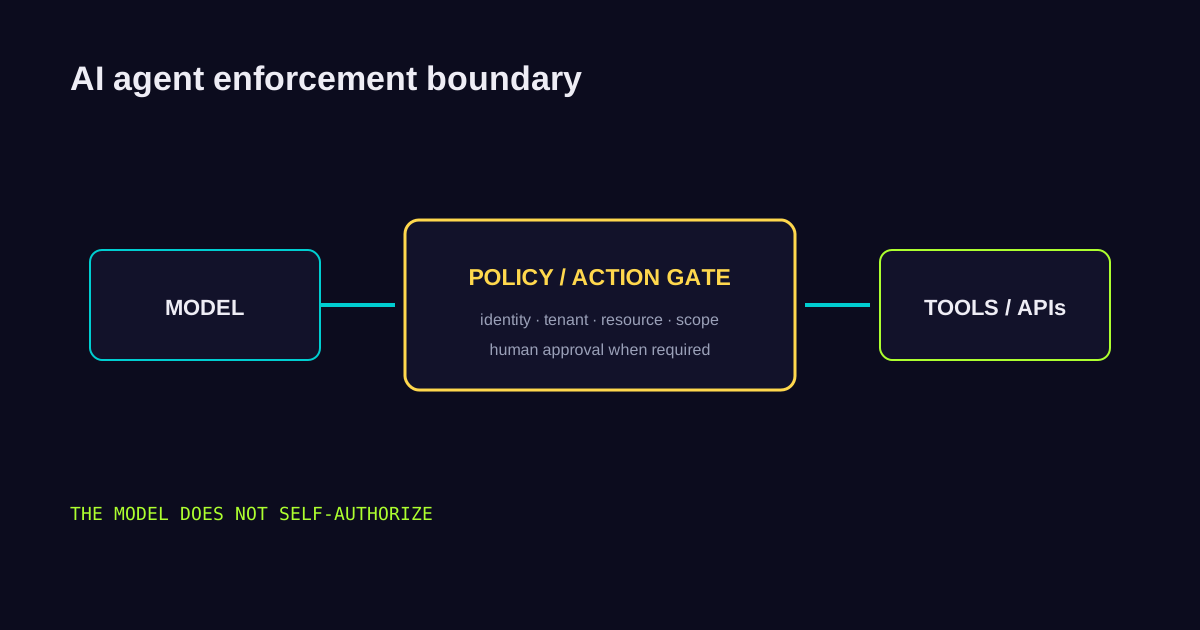
This pattern reduces the blast radius of prompt injection, hallucinated actions, compromised context, and simple model error. It also creates a place to enforce rate limits, action budgets, transaction thresholds, approval gates, and kill switches.
Integrations expand the product’s attack surface
Every OAuth connection, webhook, API key, SaaS connector, and data synchronization job extends the product’s trust graph.
The integration should therefore have its own security contract:
- what data leaves the platform;
- what data can enter;
- which tenant authorized the connection;
- which scopes were granted;
- how tokens are stored;
- how tokens expire or revoke;
- what webhook signatures or request validation are required;
- how duplicates and replays are handled;
- what happens when the vendor is unavailable;
- how the integration is disconnected cleanly;
- what logs exist for significant actions.
Shadow integrations deserve attention as well. CSA’s research describes widespread SaaS adoption and administration outside centralized security visibility. A product team may also create its own version of shadow connectivity when engineers add vendor tools or AI services without registering the data path and owner.
A useful rule is simple: if a new integration can read customer data or take an action, it belongs in the architecture inventory before production.
Observability, revocation, and recovery
Security controls are incomplete if the team cannot tell when they failed.
For high-value actions, logs should preserve enough context to answer:
- which principal acted;
- which tenant was involved;
- which resource was affected;
- which action was requested;
- which authorization rule allowed or denied it;
- whether an AI agent or integration participated;
- what the outcome was;
- whether a human approved or overrode the action.
Observability should also connect to containment. If one integration token is compromised, can it be revoked without disabling every customer? If one agent begins acting abnormally, can the team stop its tool access? If an authorization policy causes a production problem, can it be rolled back safely?
Recovery belongs in the design. NIST CSF includes Respond and Recover because prevention is not enough. SaaS systems should assume that configuration errors, credential compromise, dependency outages, software defects, and human mistakes will occur.
Useful operational controls include:
- per-identity revocation;
- short credential lifetimes where practical;
- kill switches for high-risk agent tools;
- policy versioning;
- deployment rollback;
- backup and restore testing;
- incident ownership;
- alerting on unusual authorization or data-access patterns;
- evidence retention sufficient for investigation.
Red-team the release gate
Security reviews should not end when a feature passes the happy path.
A release involving sensitive data, new authorization logic, a major integration, or an AI agent should be tested against meaningful failure cases before production.
A practical sequence is:
DEV → SECURITY REVIEW → ADVERSARIAL TEST → REMEDIATE → RETEST → HUMAN RELEASE → PRODUCTION
For an AI agent, test prompt injection, indirect instructions in retrieved content, tool misuse, privilege escalation, cross-tenant retrieval, unintended data disclosure, action chaining, replay behavior, and failure of human escalation. The exact tests should follow the real architecture rather than a generic prompt list.
Authorized red-team testing also needs rules of engagement: scope, environments, allowed methods, test data, stop conditions, contacts, evidence handling, and remediation ownership.
The objective is not to prove that the product is “unhackable.” It is to identify realistic failure paths, reduce their likelihood and impact, and produce evidence that remediation changed the result.
Frequently asked questions
What is SaaS security?
SaaS security is the set of technical and operational controls that protect users, tenants, data, identities, APIs, integrations, infrastructure, and business operations in a SaaS environment.
What is tenant isolation?
Tenant isolation prevents one customer’s users, services, data, or actions from crossing into another tenant without authorization. It must be enforced across APIs, storage, background jobs, search, caches, exports, AI retrieval, and administration—not just the user interface.
Is authentication enough for SaaS security?
No. Authentication establishes identity. Authorization decides whether that identity can perform a specific action on a specific resource in the current tenant and context.
How should SaaS companies secure AI agents?
Give agents dedicated identities, narrow tool permissions, resource- and tenant-aware authorization, logging, human approval for high-impact actions, revocation controls, and an enforcement layer outside the model.
What should a SaaS security assessment include?
It should map trust boundaries, tenant isolation, identity, authorization, non-human accounts, APIs, integrations, secrets, data paths, observability, recovery, AI-agent controls, and the product’s most important failure scenarios.
Limitations
SaaS architectures differ substantially by cloud, language, database model, tenant design, customer requirements, compliance obligations, integration strategy, and product maturity. This article is security architecture information, not a claim that one pattern fits every product.
Frameworks such as NIST CSF, NIST AI RMF, NCSC cloud guidance, CSA research, and OWASP agentic guidance provide useful structures and threat categories, but a real security program must adapt them to the product, risk model, contracts, legal obligations, and engineering capacity.
What to do next
Pick one high-value product action: export tenant data, invite an administrator, update billing, connect an integration, or let an AI agent call a tool.
Trace it from the first principal to the final side effect. Write down the tenant, resource, identity, authorization rule, credential, external systems, logs, and recovery path.
Then ask: Where does the system actually decide that this action is allowed?
If the answer is “the UI,” “the model,” “because the service is internal,” or “we assume the tenant ID is correct,” that boundary deserves engineering attention before scale magnifies it.
Sources
- Cloud Security Alliance — State of SaaS Security Report 2025
- OWASP GenAI Security Project — Top 10 for Agentic Applications for 2026
- NIST — Cybersecurity Framework
- NIST — AI Risk Management Framework
- UK NCSC — Cloud Security Guidance
