A medical practice management consultant may be brought in to improve scheduling, staffing, revenue cycle performance, patient access, or operations. But when a private practice keeps adding portals, EHR modules, billing tools, communication systems, AI products, and integrations without reducing rework, the practice may have a systems problem disguised as an operations problem.
High John Technology focuses on that systems layer.
HJT is not a medical practice-management company, clinical consultant, law firm, or compliance authority. Our role is to map how people, applications, data, identities, permissions, workflows, automation, and AI interact inside the administrative and technical side of a healthcare operation. That map helps reveal where patient state becomes inconsistent, where staff compensate for integration gaps manually, where sensitive data crosses unnecessary boundaries, and where automation is acting without a clear owner or exception path.
For organizations that handle electronic protected health information, those questions are not separate from security. HHS describes the HIPAA Security Rule as requiring appropriate administrative, physical, and technical safeguards to protect the confidentiality, integrity, and availability of ePHI. That makes identity, access, auditability, recovery, and system behavior part of the operational design—not an afterthought added after the workflow is already live.
Table of contents
- What a medical practice management consultant should map first
- The patient workflow as a state machine
- Why PM, EHR, portal, and billing systems drift apart
- ePHI data flow and access boundaries
- Administrative AI vs clinical authority
- Failure handling belongs in the architecture
- What to measure before changing the stack
- When a systems assessment makes sense
- Frequently asked questions
What a medical practice management consultant should map first
Start with one patient journey from the first administrative trigger to the final business outcome.
For many private practices, that includes inquiry or referral, registration, identity and demographics, scheduling, insurance eligibility, forms and consent, the clinical encounter, documentation, coding, claim creation, clearinghouse submission, payer response, patient responsibility, payment, follow-up, and future recall or care coordination where applicable.
The software stack may include a patient portal, practice-management system, EHR or EMR, clearinghouse, payer portals, payment gateway, phone system, communications platform, analytics product, document tools, and AI services. Each application can be functioning correctly while the combined workflow still fails.
A useful operating map asks:
- What is the patient or encounter state at this point?
- Which system owns that state?
- Which employee or team owns the next action?
- What information is required before the workflow advances?
- Which roles and systems may read or change the data?
- What action needs licensed clinical authority rather than administrative automation?
- What happens when an integration fails or data conflicts?
- What evidence is logged?
- What metric tells leadership that the failure is improving?
Those questions create a shared model before anyone proposes another tool.
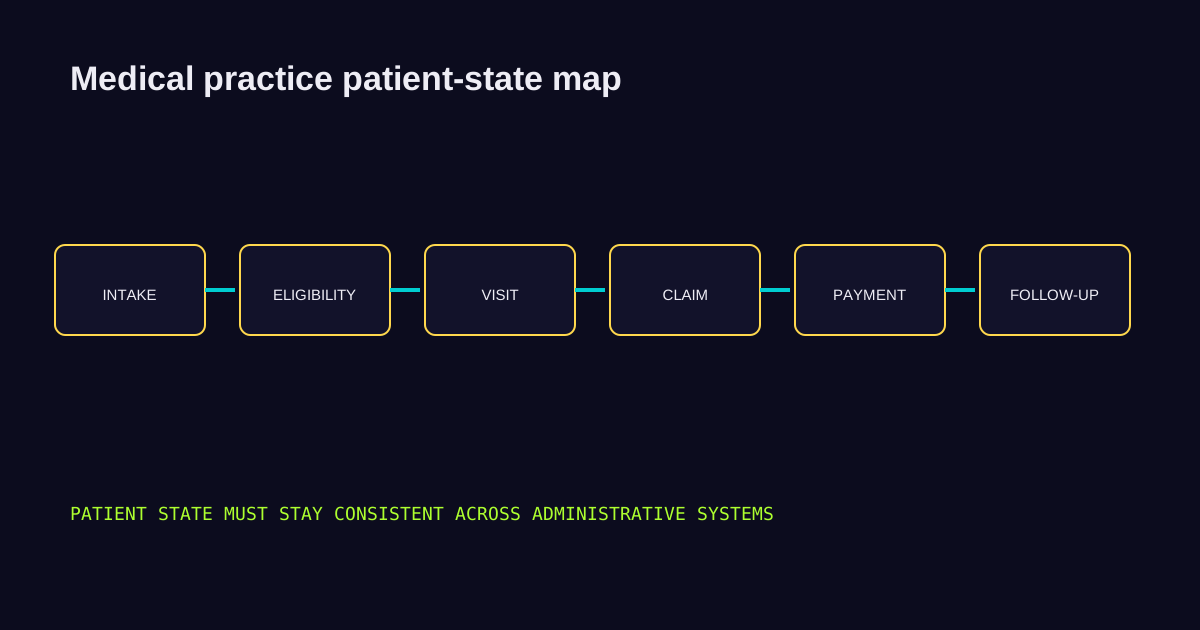
The patient workflow as a state machine
A practice can reduce a great deal of operational confusion by treating administrative workflow as explicit state.
A patient may be registered but missing insurance information. An appointment may be scheduled but awaiting authorization. An encounter may be complete while documentation is unsigned. A claim may be generated but rejected by the clearinghouse. A payer may adjudicate the claim while the patient ledger remains unreconciled.
If those conditions are represented only by notes, inbox messages, or staff memory, the practice has weak state management. A reliable workflow should define the current state, next allowed state, required evidence, responsible owner, and exception path.
For example, a claim should not be treated as successfully submitted merely because a staff member clicked “send.” The workflow should distinguish created, validated, transmitted, accepted by the clearinghouse, accepted by the payer, adjudicated, paid, denied, or requiring correction where those states matter to the practice.
The same idea applies upstream. A scheduled patient with incomplete administrative prerequisites should not look identical to a patient who is ready for the visit. The software does not need to use those exact labels, but the operating model should make the distinction visible.
This matters because reporting inherits the quality of the state model. If the states are ambiguous, dashboards become activity reports instead of decision tools.
Why PM, EHR, portal, and billing systems drift apart
Healthcare technology frequently separates administrative and clinical functions. A practice-management system may handle scheduling and financial ledgers. An EHR or EMR may hold clinical documentation. A portal may collect patient-entered data. A clearinghouse may transmit claims. A payment vendor may hold transaction state.
Integration creates convenience, but it also creates reconciliation questions.
Suppose a patient changes an address in the portal. Which system becomes authoritative? Does the update flow to the PM system, EHR, or both? What happens if an older interface overwrites the new value? If eligibility returns a different name or plan, does a human review the discrepancy before the claim workflow proceeds?
A well-designed integration needs a contract beyond “System A connects to System B.” Document:
- the business object being synchronized;
- the fields in scope;
- source and destination;
- authoritative system for each critical value;
- trigger and timing;
- identity or credential used;
- validation rules;
- error and retry behavior;
- duplicate handling;
- reconciliation process;
- escalation owner.
That is how a medical practice management consultant and a systems engineer can complement each other: one defines how the business should run; the other ensures the technology can represent and enforce that model.
ePHI data flow and access boundaries
For practices subject to HIPAA, ePHI cannot be treated as a generic application payload. HHS’s Security Rule summary identifies access control, audit controls, authentication, integrity, and transmission security among the technical safeguards relevant to covered ePHI environments.
The first engineering step is to map where ePHI exists and where it travels.
That map may include the EHR, PM system, portal, imaging, backups, email, document repositories, communications vendors, billing partners, clearinghouses, analytics, AI tools, and endpoints used by staff. It should also include the identities involved: physicians, nurses, medical assistants, front-office staff, billing specialists, administrators, vendors, service accounts, and non-human workloads.
Then ask whether each access path is necessary for the task.
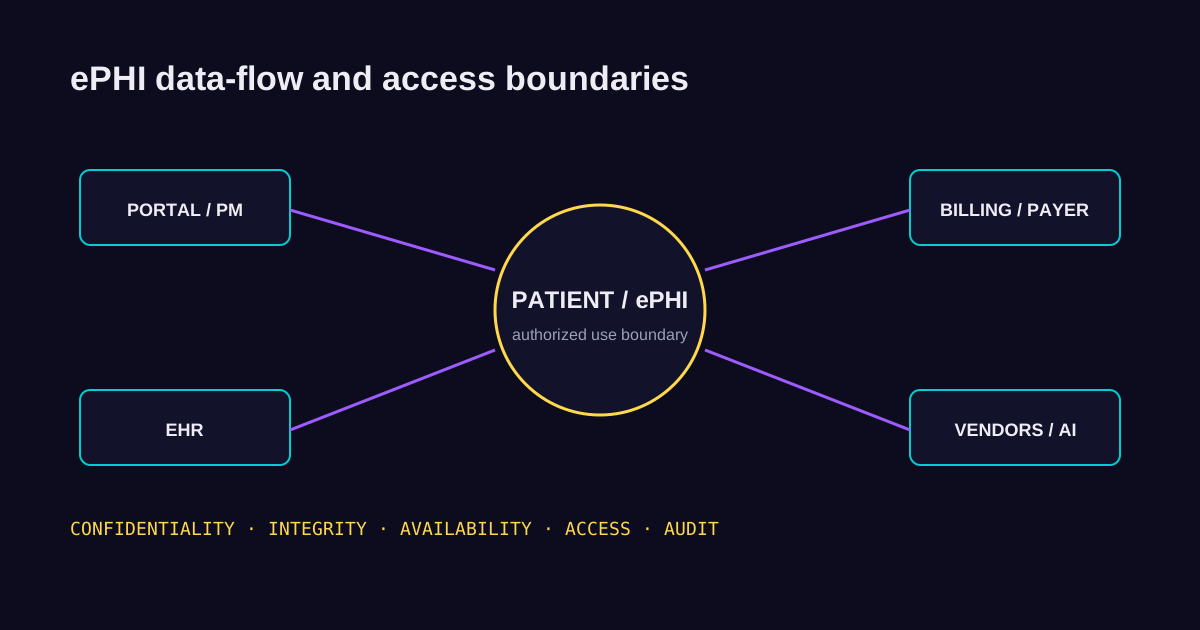
Least privilege does not mean making the practice unusable. It means the role, application, or agent receives the access needed for the defined task without inheriting unnecessary authority.
Useful controls can include role-based access, MFA, separate service identities, credential rotation, audit logging, secure transmission, backup and recovery, vendor due diligence, endpoint controls, and a documented access lifecycle. The exact implementation depends on the environment and applicable requirements.
HHS has also published voluntary healthcare cybersecurity performance goals that emphasize foundational practices such as mitigating known vulnerabilities, email security, MFA, training, incident planning, and network segmentation. Those goals can help frame technical hardening, but they should not be treated as proof that a specific practice is compliant simply because a checklist was completed.
Administrative AI vs clinical authority
AI can help a medical practice with administrative work, but an architecture should make the boundary between assistance and clinical authority explicit.
Potential administrative use cases can include call routing, FAQ responses based on approved information, scheduling support, form extraction, summarization, referral routing, eligibility assistance, coding-support workflows, documentation assistance, or patient-message triage. Each one has a different data and risk profile.
A useful design test asks four questions:
- What can the AI read?
- What can the AI write or change?
- What happens if the output is wrong?
- Who remains accountable for the decision?
The more consequential the action, the stronger the boundary should be.
An AI system that proposes an appointment slot is different from a system that changes medication, issues clinical advice, modifies a signed clinical note, or makes a treatment decision. HJT’s default posture is to keep clinical authority with the appropriately licensed human and use AI as an assisting component unless a validated, authorized workflow explicitly supports something more.
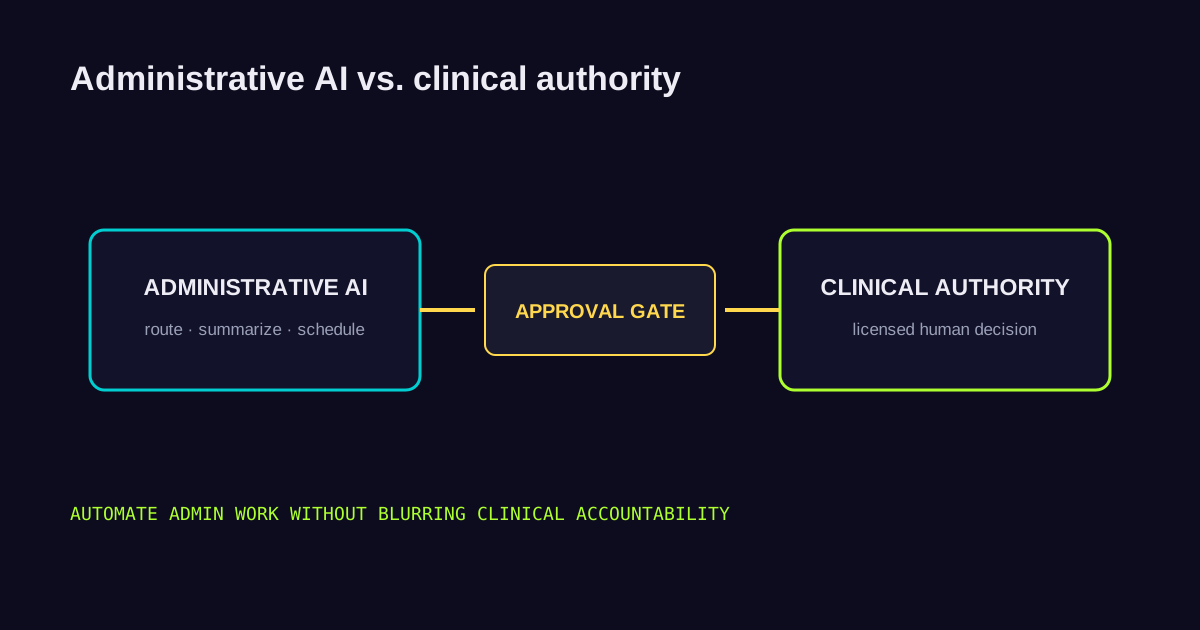
AI governance should also include model or vendor inventory, approved use scope, data classification, human review, logging, evaluation criteria, escalation, rollback, and change management. NIST’s AI Risk Management Framework is useful as a voluntary structure for governing, mapping, measuring, and managing AI risk, but implementation should still be tailored to the practice’s actual use case and obligations.
Failure handling belongs in the architecture
Medical practices often design workflows around the happy path: the form submits, eligibility responds, the interface sends the message, the clearinghouse accepts the claim, and the AI classifies the request correctly.
Reliable systems are defined by what happens when that sequence breaks.
For every high-value workflow, document at least:
- timeout behavior;
- retry policy;
- duplicate protection;
- invalid-data handling;
- manual fallback;
- escalation owner;
- patient communication when appropriate;
- logging and evidence preservation;
- recovery procedure;
- stop condition if continuing would make the problem worse.
An integration that silently fails is more dangerous operationally than one that fails loudly and creates an owned task.
The same is true for AI. If the system cannot confidently route a patient message, the correct behavior may be to escalate rather than improvise. If the model’s tool call violates a policy, the action should be denied outside the model.
What to measure before changing the stack
A practice should establish a baseline before replacing software or adding automation. Otherwise the project produces activity without a reliable before-and-after comparison.
Depending on the problem, useful measures may include:
- time from referral or inquiry to scheduled appointment;
- registration or form-completion rate before arrival;
- eligibility exceptions requiring manual work;
- appointment cancellation and no-show recovery;
- claim rejection and denial rates;
- rework caused by missing or conflicting information;
- days in accounts receivable;
- patient-balance collection timing;
- interface or integration failure count;
- support tickets related to system handoffs;
- account lifecycle errors;
- manual overrides;
- AI escalation rate and reviewed-error rate;
- time from detected failure to recovery.
The practice does not need a dashboard with fifty metrics. It needs the small set that represents the bottleneck being changed.
When a systems assessment makes sense
A traditional medical practice management consultant may be best when the main problem is staffing, compensation, provider productivity, scheduling policy, payer strategy, leadership, or business coaching.
A systems assessment becomes useful when the problem crosses technical and operational boundaries. Typical signals include:
- staff copy the same information between systems;
- patient state disagrees across PM, EHR, portal, or billing tools;
- integrations fail without visible alerts;
- new AI vendors are entering workflows without a shared governance process;
- leadership cannot trace where an administrative workflow stalls;
- shared accounts or unclear service identities make activity hard to attribute;
- security requirements and operational shortcuts conflict;
- a multi-location practice needs consistent controls across sites;
- a vendor feature cannot represent the required workflow and custom middleware may be justified.
HJT’s assessment model starts with the real objects, relationships, workflows, data, identities, and failures. Then it recommends the smallest intervention that creates a measurable improvement while respecting the practice’s authority and security boundaries.
Frequently asked questions
What does a medical practice management consultant do?
The role varies and may include operations, staffing, scheduling, finance, revenue cycle, productivity, and strategic management. HJT focuses on the technology and systems layer that supports those functions.
What is the difference between practice-management software and an EHR?
Practice-management systems commonly support administrative functions such as scheduling, registration, and financial workflows, while EHR or EMR systems focus more heavily on clinical documentation and patient records. Product boundaries vary, and many platforms combine capabilities.
Can a medical practice use AI for administrative work?
Yes, depending on the use case, data, product, and applicable requirements. Define what the AI may read, write, decide, and escalate before deployment. Higher-impact clinical decisions should retain appropriate licensed human authority.
Does a systems assessment guarantee HIPAA compliance?
No. A technical assessment can identify and improve controls within scope, but compliance depends on the organization’s full legal, administrative, physical, technical, contractual, and operational circumstances.
What should be mapped before integrating a new healthcare application?
Map the data involved, authoritative systems, identities, permissions, transmission path, validation rules, error handling, retries, audit requirements, vendor responsibilities, and operational owner.
Limitations
Medical practices vary by specialty, ownership, location, payer mix, clinical workflow, applicable law, contractual obligations, and technology stack. This article is technical and operational information, not medical, legal, billing, or compliance advice.
Product capabilities and healthcare regulations change. A real implementation should verify the current environment and obtain qualified legal, compliance, security, and clinical guidance where required.
What to do next
Pick one workflow that causes recurring administrative rework. Trace one real patient through it and record every system, status, handoff, role, permission, exception, and manual workaround.
Then ask: Where did the system stop representing reality accurately?
That point is often more valuable than another feature comparison. It tells the practice what must be corrected before new automation is scaled.
Sources
- U.S. HHS — Summary of the HIPAA Security Rule
- U.S. HHS — Healthcare and Public Health Cybersecurity Performance Goals
- NIST — Cybersecurity Framework
- NIST — AI Risk Management Framework
- ASTP/ONC — HTI-1 Final Rule
