A dental practice management consultant can help a practice improve scheduling, staffing, collections, treatment acceptance, and day-to-day operations. But when the same problems keep returning after new software, new scripts, or another vendor rollout, the root cause may be deeper: the practice does not have a clear operating model for how patients, data, work, permissions, and decisions move across its systems.
That is the systems layer High John Technology examines.
HJT does not position itself as a clinical dental consultant. We approach the practice as an interconnected operating environment: patient inquiry, intake, scheduling, eligibility, clinical documentation, treatment planning, financial coordination, billing, collections, recall, AI tools, vendors, and the identities allowed to touch each part. The goal is to determine where the workflow loses state, creates duplicate work, exposes unnecessary data, or depends on a person remembering what the software should have enforced.
That distinction matters more as dental AI adoption grows. The American Dental Association reported in July 2026 that 43.3% of responding dentists were already using AI for at least one task, with additional respondents planning future use. The same ADA research shows a clear difference between administrative use cases and high-level clinical decision making. That is a strong reason to design AI around explicit authority boundaries instead of treating every use case as equivalent.
Table of contents
- What a dental practice management consultant should map first
- The patient journey as the operating model
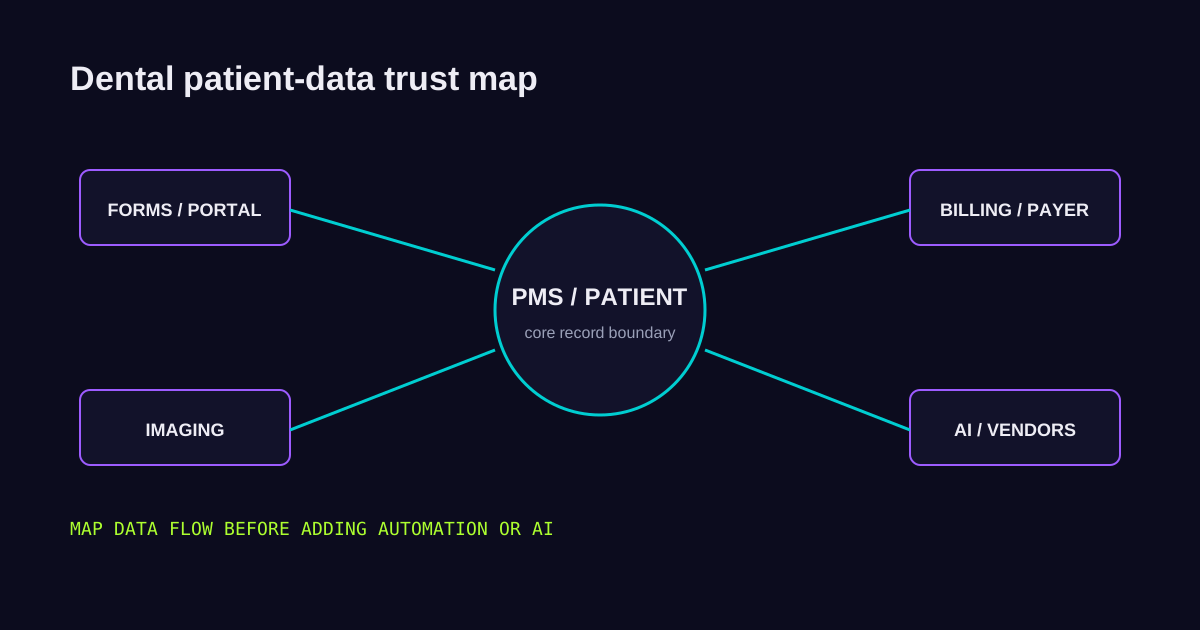
- Why the PMS is important but not the whole system
- Where dental office workflows commonly break
- How to add AI without blurring authority
- Cybersecurity belongs inside workflow design
- What to measure before and after a change
- When outside systems engineering makes sense
- Frequently asked questions
What a dental practice management consultant should map first
Before recommending a new platform, automation, AI receptionist, or reporting layer, map the real work.
A useful starting point is the patient journey. Where does a new patient first enter? Which system creates the patient record? Who verifies insurance? What happens when information is incomplete? Which team member owns an unscheduled treatment plan? What system is authoritative for billing state? Which vendors receive patient information? What does an AI tool see, and what can it change?
Those questions expose architecture that a feature checklist will miss.
A strong dental operating map should include at least four views:
- Workflow: what happens from inquiry through payment and recall;
- System: which PMS, imaging, communications, billing, analytics, phone, and AI tools participate;
- Authority: who can read, write, approve, override, or disclose information;
- Measurement: which metrics prove that the workflow is improving rather than simply producing more activity.
The point is not to produce a giant diagram. It is to make hidden assumptions visible before technology is added on top of them.
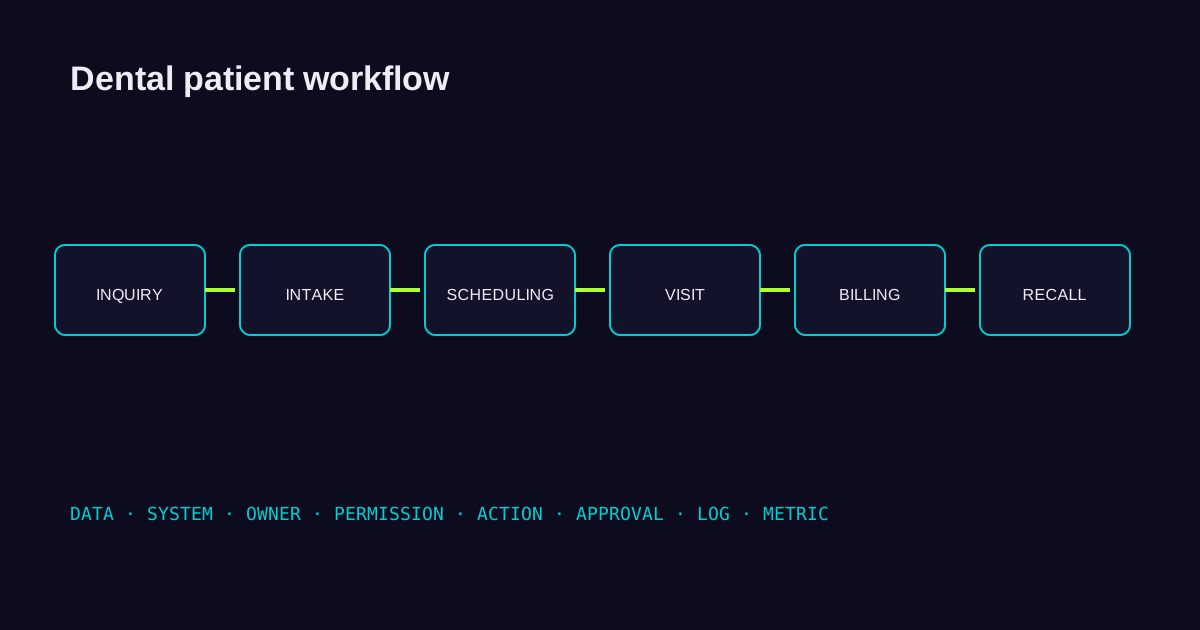
The patient journey as the operating model
A dental practice is not one workflow. It is a chain of connected states.
A patient may begin as an inbound call, online form, referral, or returning patient. The practice then captures demographics, schedules the appointment, collects forms, verifies eligibility, prepares the clinical team, documents the visit, creates or updates a treatment plan, presents financial options, submits claims, posts payments, follows up on outstanding balances, and attempts recall or reactivation when appropriate.
Each stage has a business object and a state. A patient can be scheduled but incomplete on forms. A treatment plan can be diagnosed but unscheduled. A claim can be submitted but not adjudicated. A balance can be posted but not collected.
If the practice only sees a person in the PMS without seeing the state of the work around that person, staff compensate manually. Spreadsheets appear. Sticky notes appear. Side conversations become part of the process. That may work at low volume, but it creates fragility as the practice grows or adds locations.
This is why HJT treats workflow state as a design problem. Every important state should have an owner, required information, a next action, an exception path, and a metric.
For example, a canceled appointment should not simply disappear from the schedule. The process should define whether the patient enters a rebooking queue, who owns the follow-up, how many attempts are appropriate, when the patient leaves the queue, and how the practice measures recovered chair time.
Why the PMS is important but not the whole system
Practice-management software is usually the operational center of a dental office, but the technology stack often extends far beyond it. Imaging, patient communications, phone systems, online forms, payment tools, analytics, clearinghouses, insurance tools, and AI products may all connect to the patient journey.
The important architectural question is not whether these systems are integrated. It is whether the practice knows what each integration is allowed to do and which system owns which information.
Suppose an online intake tool updates demographics in the PMS. What happens when the patient enters conflicting information? Does the integration overwrite the existing record automatically? Does a staff member review the change? Is the source preserved? Can the practice reconstruct what changed later?
Or consider an AI receptionist. Booking an appointment is not just adding a calendar event. The system may need to know provider, location, appointment type, duration, eligibility rules, age restrictions, and escalation conditions. If that logic lives only in a prompt, the system has no reliable enforcement boundary.
Where dental office workflows commonly break
Many dental workflow problems are ordinary operating failures, not exotic technology failures.
Incomplete intake
Forms arrive late or partially complete. Insurance images are unreadable. A patient enters the same information in multiple places. Staff re-key data because an integration does not write to the correct field.
Scheduling without state control
Appointments are booked, but prerequisites are missing. A cancellation creates an empty chair without an automatic recovery path. The short-call list exists but depends on one employee remembering to use it.
Treatment plans without ownership
A patient leaves with diagnosed treatment but no clear owner for follow-up. The system contains the treatment plan, but the business process does not define who advances it from unscheduled to scheduled or closed.
Billing and insurance handoff gaps
Clinical documentation, procedure codes, claim state, patient responsibility, and payment status can live across different workflows. When those states disagree, staff spend time reconciling rather than moving the work forward.
Tool sprawl
A new communications platform, AI tool, analytics layer, or vendor solves one problem but creates another integration. The practice becomes more dependent on connectors while gaining no central view of where failures occur.
A dental practice management consultant focused on operations may solve parts of these problems through training and SOPs. A systems-engineering partner focuses on making the technology and controls support those SOPs consistently.
How to add AI without blurring authority
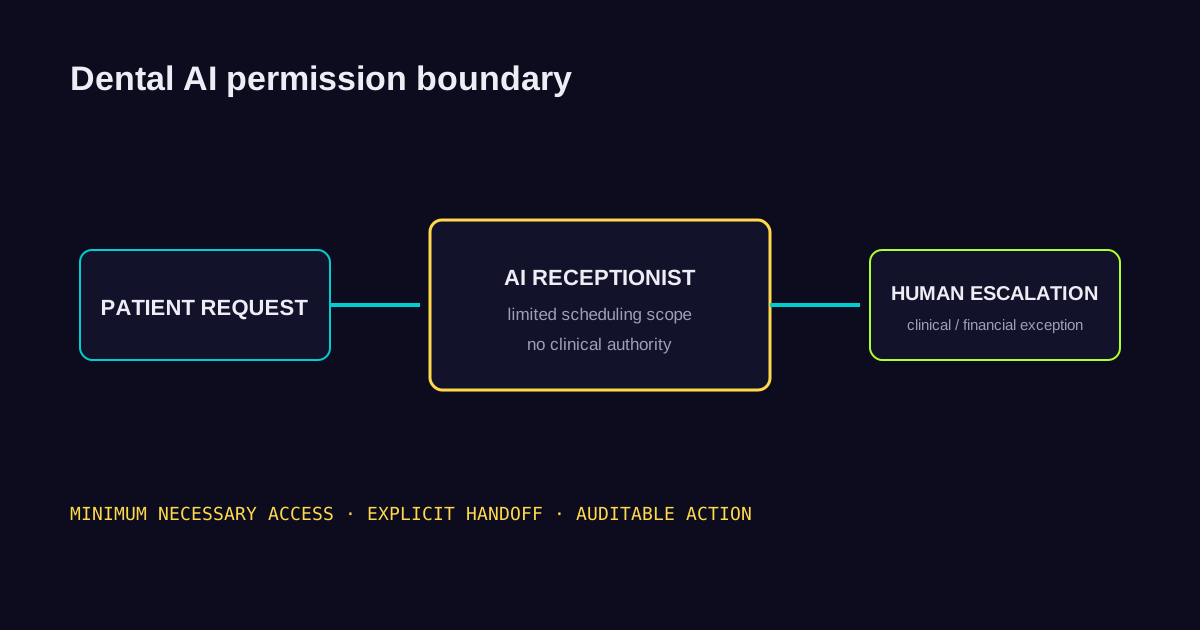
Dental AI should be designed around the authority of the task.
Administrative tasks such as routing calls, answering approved FAQs, sending reminders, extracting information from forms, or proposing appointment slots can be good candidates for automation or AI assistance when the surrounding rules are clear.
Clinical judgment is different. ADA’s 2026 survey found that responding dentists were far more cautious about high-level clinical decisions than administrative efficiency tasks. That distinction should exist in the architecture as well as the policy.
For an AI receptionist, define:
- what data it needs for the current task;
- which PMS fields it can read;
- which fields, if any, it can write;
- which appointment types it may schedule automatically;
- which financial questions require staff review;
- which clinical requests must be escalated;
- what happens if the caller’s identity or intent is uncertain;
- how every action is logged;
- how staff can stop or override the system safely.
The model should not decide its own authority. Permissions, validation, and approval belong outside the model in deterministic controls.
Cybersecurity belongs inside workflow design
For covered dental practices, HIPAA obligations are not a marketing label. HHS says the Security Rule requires appropriate administrative, physical, and technical safeguards for electronic protected health information. The ADA’s HIPAA guidance also emphasizes risk assessment and the minimum-necessary principle in covered dental settings.
That means security questions belong inside workflow design:
- Which workforce roles need access to which patient data?
- Which vendors are business associates, where applicable?
- How are accounts created, changed, and disabled?
- Is MFA used where appropriate?
- Are shared credentials hiding individual accountability?
- Are logs sufficient to reconstruct significant access or changes?
- What happens if a vendor integration is compromised or unavailable?
- Can the practice recover critical data and operations after ransomware or another outage?
The ADA’s cybersecurity guidance specifically recommends reducing unnecessary sensitive-data handling, maintaining security updates, using appropriate safeguards, and having an emergency plan. Those controls become more important as practices add cloud tools and AI integrations.
Security architecture should not be used to claim that a practice is automatically “HIPAA compliant.” Compliance depends on the facts, the applicable requirements, policies, contracts, implementation, and ongoing operations. HJT’s role is to design and assess technical and operational controls within an agreed scope.
What to measure before and after a change
A technology project should begin with a baseline.
For a dental workflow, useful operational measures may include:
- inbound call answer rate;
- new-patient booking rate;
- percentage of patients completing forms before arrival;
- cancellation and no-show recovery;
- time spent re-entering or correcting patient information;
- unscheduled treatment inventory and follow-up completion;
- insurance eligibility exception rate;
- clean-claim rate and claim rework;
- days in accounts receivable;
- patient balance collection state;
- failed integration events;
- manual override frequency;
- AI escalation and error rates where AI is used.
Not every practice needs every metric. Choose the few that represent the problem being solved.
A 30-day systems improvement should not promise a magical revenue percentage. A more defensible goal is to make one workflow measurable, establish ownership, remove one high-friction handoff, and prove that the control works under normal and exception conditions.
When outside systems engineering makes sense
A dental practice management consultant may be the right partner when the central problem is leadership, training, compensation, team accountability, clinical scheduling philosophy, or practice-management coaching.
A systems-engineering partner becomes useful when the problem crosses software and operational boundaries. Signals include:
- the practice has multiple locations or departments using inconsistent workflows;
- the PMS is surrounded by many integrations;
- staff re-enter the same information repeatedly;
- AI tools are being added without a shared governance model;
- leadership cannot tell where a patient or revenue workflow is stuck;
- a security requirement conflicts with an operational shortcut;
- a vendor claims an integration is working but staff still reconcile manually;
- the practice needs a custom application, middleware, or control layer rather than another standalone SaaS product.
HJT’s approach is to map the system before choosing the intervention. Sometimes the current tools are sufficient and need better configuration. Sometimes a process needs clearer ownership. Sometimes an integration needs to be repaired. Sometimes AI is justified. Sometimes it is not.
Frequently asked questions
What does a dental practice management consultant do?
The role varies. Consultants may help with scheduling, staffing, collections, treatment acceptance, leadership, financial performance, and operations. HJT’s systems-focused work is narrower: we map the technology, data, workflow, authority, automation, and security layers that support the operation.
When should a dental practice consider AI?
Start with a specific workflow and measurable problem. Define the data the AI needs, what it may do, what remains human-authorized, how errors are handled, and how results will be measured before choosing a product.
Can an AI receptionist schedule dental appointments?
Yes, depending on the product and practice rules. The important question is whether scheduling constraints, patient identity, appointment types, escalation rules, PMS permissions, and audit logging are designed safely around it.
Is every dental practice subject to HIPAA?
No. HIPAA coverage depends on facts such as whether the practice is a covered entity. The ADA explains that dental practices conducting covered electronic transactions can be covered entities. Practices should obtain appropriate legal or compliance guidance for their circumstances.
What should a dental systems assessment include?
At minimum, it should map the patient journey, core systems, integrations, data flows, role permissions, AI use, failure paths, current metrics, and the specific business outcome the practice wants to improve.
Limitations
Dental practices differ by specialty, size, payer mix, ownership, state law, technology stack, staffing model, and whether HIPAA applies. This article is systems-engineering information, not dental, legal, clinical, or compliance advice.
Vendor features and regulatory requirements also change. Any implementation should verify current product capabilities and applicable obligations before design decisions are finalized.
What to do next
Pick one patient workflow that repeatedly creates rework. Trace it from the first trigger to the final outcome. Write down every system it touches, every data handoff, every role, every exception, and every point where staff leave the system to resolve the issue manually.
Then ask: Is the failure caused by the people, the process, the software, the integration, the permissions—or the fact that nobody designed how those pieces should work together?
That answer tells you what kind of help the practice actually needs.
Sources
- American Dental Association — Dentists AI Usage and Attitudes, July 2026
- American Dental Association — HIPAA 20 Questions
- American Dental Association — Tips to Safeguard Your Practice from Computer Hackers
- U.S. HHS — Summary of the HIPAA Security Rule
- NIST — AI Risk Management Framework
