Law firm management services often begin with staffing, intake, productivity, case management, billing, or growth. Those are legitimate operating problems. But when a firm adds a new case-management system, intake platform, AI tool, document workflow, or dashboard and the same friction returns, the missing layer may be architecture: nobody has defined how a prospective client becomes an authorized matter, how information crosses system boundaries, who owns each state, or what an AI system is allowed to do with privileged or confidential material.
High John Technology looks at that layer.
HJT is not a law firm and does not provide legal advice. Our role is systems engineering: mapping identities, workflows, applications, data, integrations, permissions, automation, AI use, failure paths, and evidence so the technology supports the firm’s operating rules rather than silently undermining them.
That distinction matters now because legal AI is moving from experimentation into daily work. Thomson Reuters’ 2026 research reports strong AI adoption across professional work and, in its law-firm analysis, found that 34% of law-firm professionals surveyed were using AI tools their firms had not authorized. The American Bar Association’s Formal Opinion 512 also makes clear that lawyers using generative AI must consider duties including competence, confidentiality, supervision, communication, candor, and reasonable fees. The engineering implication is straightforward: a firm needs more than an approved-tool list. It needs a controlled operating model for how technology participates in legal work.
Table of contents
- What law firm management services should map first
- The law firm lifecycle as a system
- The intake and conflict gate
- Matter isolation as an architecture rule
- Legal AI needs delegated authority
- Why software integration is not enough
- Operational metrics that expose failure
- When systems engineering belongs in the engagement
- Frequently asked questions
What law firm management services should map first
Start with the lifecycle, not the software catalog.
A prospective client may enter through a website form, referral, phone call, chat, advertising campaign, or intake partner. The firm gathers enough information to determine whether the inquiry belongs in the firm’s practice area and whether an engagement is possible. That information may feed a conflict review, consultation, engagement letter, payment process, matter creation, document workspace, task plan, time or cost tracking, work product, billing, settlement or closeout, and future referral or retention process.
Every transition carries questions that software alone cannot answer:
- What facts are required before the matter can advance?
- Who owns the next decision?
- Which system is authoritative for the client and matter state?
- What data may be collected before an attorney-client relationship exists?
- What information must remain separated by matter?
- What can staff, vendors, and AI systems access?
- What actions need attorney or other authorized human review?
- What event should create a log, task, alert, or escalation?
- What metric shows whether the process is actually improving?
A law firm management engagement that ignores those questions can optimize individual tasks while leaving the operating system ambiguous.
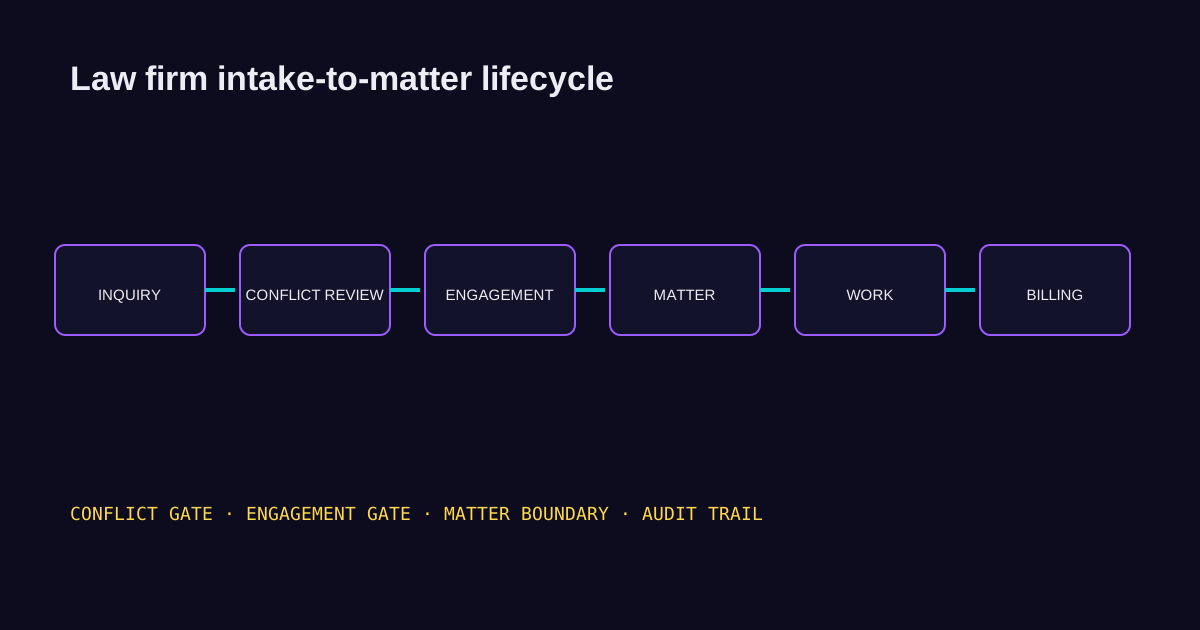
The law firm lifecycle as a system
A useful law-firm operating map can be simplified to:
Inquiry → intake → conflict review → engagement → matter creation → legal work → billing or disbursement → closeout
That sequence looks obvious until different applications represent it differently. Intake software may treat a prospect as qualified while the case-management system has no matter yet. A CRM may mark a lead as converted while the engagement letter remains unsigned. A document system may already contain uploaded material before the firm has decided whether it can accept the representation.
That is why state matters.
A mature workflow defines what each state means and what evidence is required to leave it. For example, “engaged” may require a signed agreement and any required payment condition under the firm’s own policy. “Matter Open” may require a completed conflict process and a designated responsible attorney. The exact rules are firm-specific. The systems principle is universal: the status shown by the software should represent an operational truth, not merely the last button someone clicked.
This also improves management reporting. If states are precise, leadership can measure time from inquiry to consultation, consultation to engagement, engagement to matter creation, and matter stage to matter stage without manually cleaning the data first.
The intake and conflict gate
Legal intake is a revenue system and a risk boundary at the same time.
The firm wants to respond quickly, qualify the opportunity, collect enough information, and schedule the right next step. But intake cannot be optimized as if every inquiry should move forward automatically.
A controlled intake architecture should define:
- Required identity and contact information. Collect what is actually needed for the workflow.
- Matter type and basic facts. Enough to route the inquiry without turning an unqualified prospect into a fully created matter prematurely.
- Opposing or related parties. Structured data needed for the firm’s conflict process.
- Conflict status. A real gate, not a note someone may forget to read.
- Engagement state. The system should distinguish inquiry, consultation, prospective client, engaged client, and active matter where the firm’s rules require those distinctions.
- Document handling. Uploaded material should enter a controlled location with appropriate access and retention rules.
- Human authority. The workflow should name who may accept, reject, or escalate the prospective matter.
An intake automation can collect and route. It should not silently bypass the firm’s conflict or engagement rules because the automation is optimized for speed.
Clio’s current intake tools, for example, emphasize online forms, data capture, scheduling, and converting information into legal workflows. That is useful functionality. The HJT question sits one layer deeper: what must be true before the next system action is allowed?
Matter isolation as an architecture rule
Once a matter exists, the matter boundary should shape authorization.
A user who can work on Matter A should not automatically be able to retrieve Matter B simply because both matters live in the same document repository, knowledge base, vector store, or AI platform. This becomes especially important when firms connect generative AI to internal documents.
The safe design principle is permission-aware retrieval. The AI system should only retrieve material the requesting principal is already authorized to access, and that enforcement should happen at the retrieval or authorization layer—not only in the user interface.
Matter isolation requires more than folders. It can involve:
- role and matter membership;
- ethical-wall rules where applicable;
- client- or matter-specific access groups;
- search and retrieval filters enforced server-side;
- separate indexes or tenant boundaries for higher-risk use cases;
- logs that retain the user, matter, resource, action, and decision context.
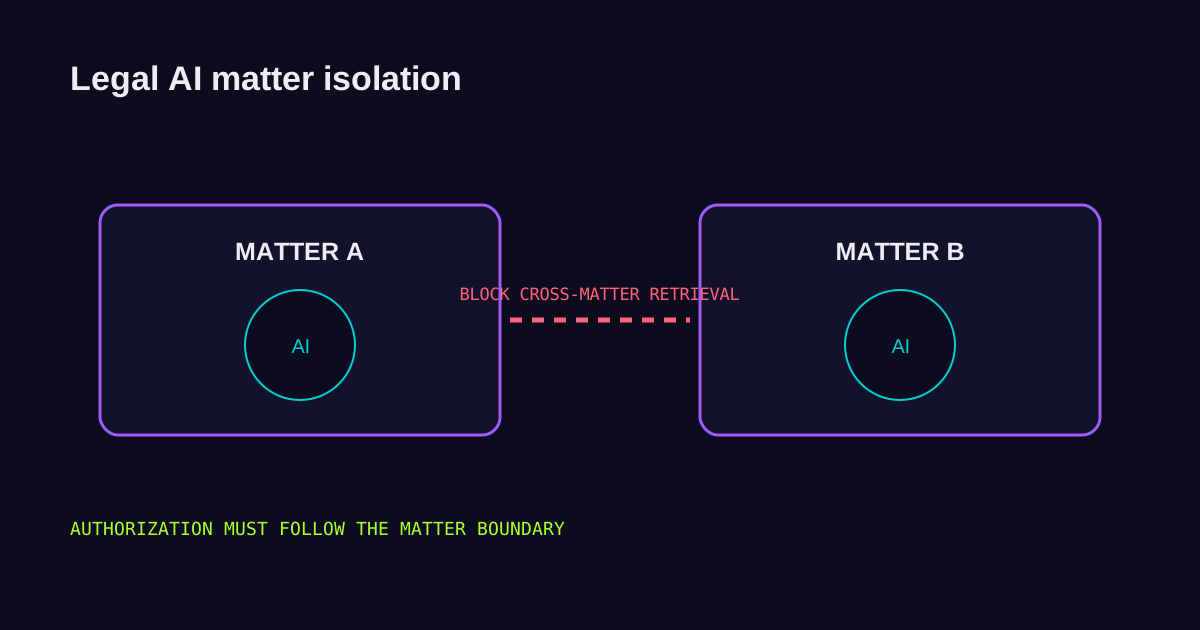
The mistake is assuming that because a user has authenticated successfully, every downstream resource is therefore safe to retrieve. Authentication proves identity. Authorization decides what that identity may do with a specific resource in a specific context.
Legal AI needs delegated authority
ABA Formal Opinion 512 does not prescribe one technology architecture, but it does make the professional responsibilities around generative AI impossible to ignore. Lawyers need to understand the capabilities and limitations of the technology they use and consider confidentiality, supervision, communication, and review obligations.
From an engineering perspective, an AI system should not borrow a person’s broad authority without controls.
For every legal AI workflow, map:
- the human requestor;
- the AI application or agent;
- the matter context;
- the documents or data sources;
- the tools or APIs the system may call;
- the actions it may perform;
- the actions that require human approval;
- the output destination;
- the audit trail.
A drafting assistant that produces text for attorney review has a different authority profile from an agent that can send client communications, update case-management records, initiate filings, or move money. The second category needs stronger deterministic controls because the system can create external effects.
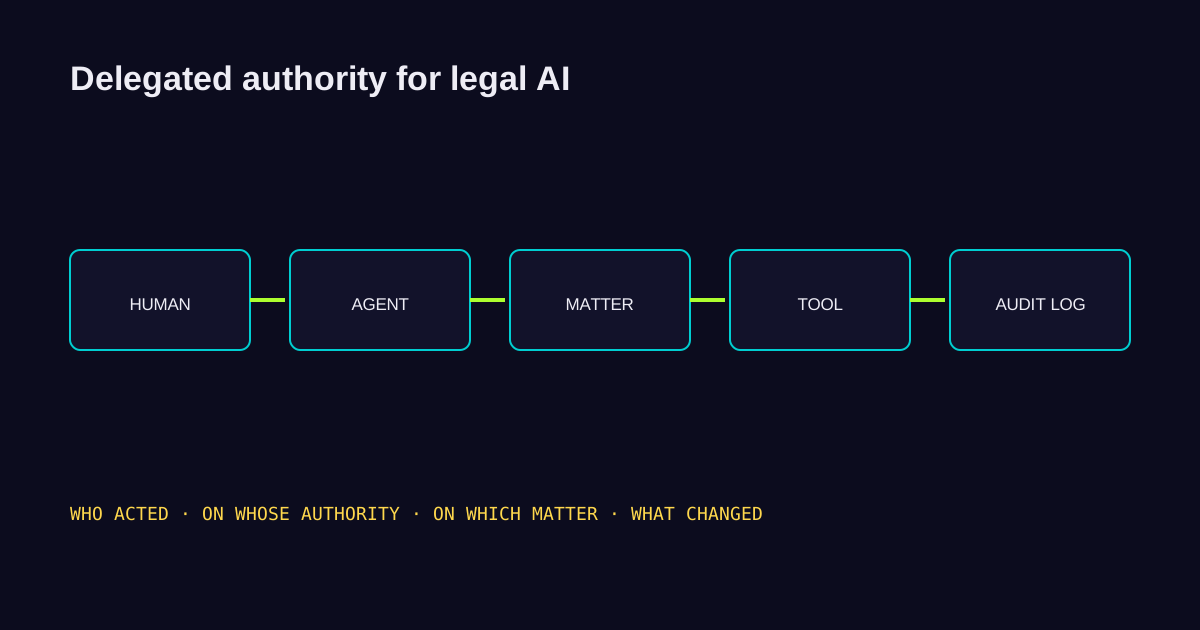
The model should not self-authorize. If an action requires approval, the enforcement point should sit outside the model and block the tool call until the required condition is satisfied.
Why software integration is not enough
Law firms may connect intake, CRM, case management, document management, accounting, e-signature, communications, calendaring, and AI systems. The architecture gets complicated because the same client or matter can be represented in multiple places.
Every integration should answer:
- Which business object moves across the connection?
- Which fields move?
- In which direction?
- Which system owns the authoritative value?
- What credential or identity performs the action?
- What happens if the write fails?
- Does the process retry safely?
- Can duplicate matters or tasks be created?
- How does the system reconcile conflicting values?
- Who is alerted when the integration breaks?
Without those answers, a “seamless integration” can still produce silent data divergence.
AI adds another layer because the system may generate or transform information before writing it somewhere else. A summary can be useful. A summary automatically overwriting the authoritative case record is a different risk decision.
Operational metrics that expose failure
A good law-firm system should help leadership see where work stalls and where risk accumulates.
Depending on practice area, useful metrics may include:
- inquiry-to-response time;
- intake completion rate;
- qualified-inquiry-to-consultation rate;
- consultation-to-engagement rate;
- time from engagement to matter creation;
- conflict-review turnaround time;
- incomplete intake percentage;
- matters with missing responsible owner;
- time in matter stage;
- overdue tasks and unresolved blockers;
- document retrieval or integration errors;
- unauthorized or failed AI-access attempts;
- AI human-review rate;
- billing cycle time and accounts-receivable aging;
- manual override and exception counts.
The exact KPI set depends on the firm’s economics and practice model. A contingency practice, hourly firm, subscription practice, and fixed-fee practice will not optimize the same revenue metrics.
The point is to connect system state to management decisions.
When systems engineering belongs in the engagement
Traditional law firm management services can be the right answer when the main issue is leadership, compensation, hiring, training, case strategy, attorney productivity, or practice-specific coaching.
Systems engineering belongs when the problem crosses operational and technical boundaries, such as:
- intake, CRM, and case management disagree about client or matter state;
- staff use side spreadsheets because the primary system cannot represent the workflow;
- AI tools are being adopted without matter-aware access controls;
- the firm cannot reconstruct which person or system changed a material record;
- a new case-management platform is being implemented without a clear migration and authority model;
- multiple offices or practice groups use different processes for the same workflow;
- leadership wants automation, but exceptions and approval rules are undocumented;
- the firm needs custom middleware or software because no single product fits the operating model.
HJT starts by mapping the system and identifying the smallest intervention that addresses the actual failure. Sometimes that means better configuration. Sometimes it is a new integration. Sometimes it is a controlled AI workflow. Sometimes it is a permission redesign. Sometimes no new technology is needed.
Frequently asked questions
What do law firm management services include?
They can include operations, intake, staffing, finance, process design, case management, technology, and growth. HJT focuses specifically on the systems-engineering layer: workflows, data, identity, permissions, integrations, AI, automation, failure handling, and measurement.
Should a law firm automate client intake?
Many intake tasks can be automated, including data collection, routing, reminders, and scheduling. Conflict decisions, engagement decisions, legal judgment, and other firm-defined authority points should remain controlled by the appropriate human process.
How should a law firm use generative AI safely?
Start with approved use cases, understand the tool’s capabilities and limitations, identify the data and matters it can reach, enforce appropriate authorization, require human review where professional judgment is involved, and keep enough evidence to reconstruct significant actions.
What is matter isolation?
Matter isolation is the practice of enforcing access boundaries so users, applications, and AI systems only retrieve or act on the matters they are authorized to access. The exact implementation depends on the firm’s systems and policies.
Does HJT provide legal compliance advice?
No. HJT provides systems architecture, technical implementation, security, automation, and authorized testing within agreed scopes. Firms should use qualified legal and compliance professionals for legal interpretations and professional-responsibility decisions.
Limitations
Law firms differ by jurisdiction, practice area, ethics rules, client requirements, billing model, matter sensitivity, size, and technology stack. This article is systems-engineering information, not legal advice.
AI products also change rapidly. Before implementation, the firm should verify current vendor data-handling terms, product capabilities, retention behavior, model configuration, permissions, and contractual requirements.
What to do next
Choose one recently opened matter. Trace it backward to the first inquiry. List every system, person, decision, document, status change, permission boundary, and manual workaround that touched it.
Then trace one AI-enabled task inside that matter. Ask: Who authorized this action? What data could the system reach? What could it change? What required human judgment? Could we reconstruct exactly what happened afterward?
If those answers are unclear, the firm has an architecture problem worth mapping before it scales the automation.
Sources
- American Bar Association — Formal Opinion 512: Generative Artificial Intelligence Tools
- Thomson Reuters — Future of Professionals 2026: Legal Report
- Clio — Legal client intake resources
- NIST — Cybersecurity Framework
- NIST — AI Risk Management Framework
